Quick Overview
AI employees handle repetitive, structured tasks at a fixed monthly cost, typically $9 to $270/mo depending on the platform and plan. Freelancers charge $25 to $150/hr and bring judgment, creativity, and domain expertise that AI cannot replicate. Neither option is universally better. The right choice depends on what the work actually requires.
For high volume, predictable tasks like inbox management, data entry, scheduling, and first-response customer support, AI employees win on cost and availability. For strategic work like brand campaigns, software architecture, legal review, or anything requiring original thinking, freelancers are the only viable option.
Most businesses that get this decision wrong do so because they frame it as either/or. The practical answer for most teams with more than five people is a hybrid: AI handles the volume, freelancers handle the complexity. The mistake is assigning AI to tasks that require judgment or hiring freelancers for work that a $9/mo tool could automate in minutes.
Introduction
The default assumption in most "AI vs freelancers" discussions is that AI employees are cheaper versions of human workers. That framing misses the point entirely. AI employees and freelancers are not substitutes for each other. They solve different categories of problems.
AI employees are software tools that execute predefined workflows. They do not think, strategize, or exercise judgment. Freelancers are humans who bring experience, context, and the ability to handle ambiguity. The question is not which is "better" but which type of work you are trying to get done.
This post breaks down the actual cost comparison with real numbers, identifies the specific task categories where each option wins, explains the risks most businesses overlook, and provides a decision framework for choosing between them. It does not cover enterprise-scale workforce planning or industry-specific compliance requirements.
What Do AI Employees and Freelancers Actually Cost in 2026?
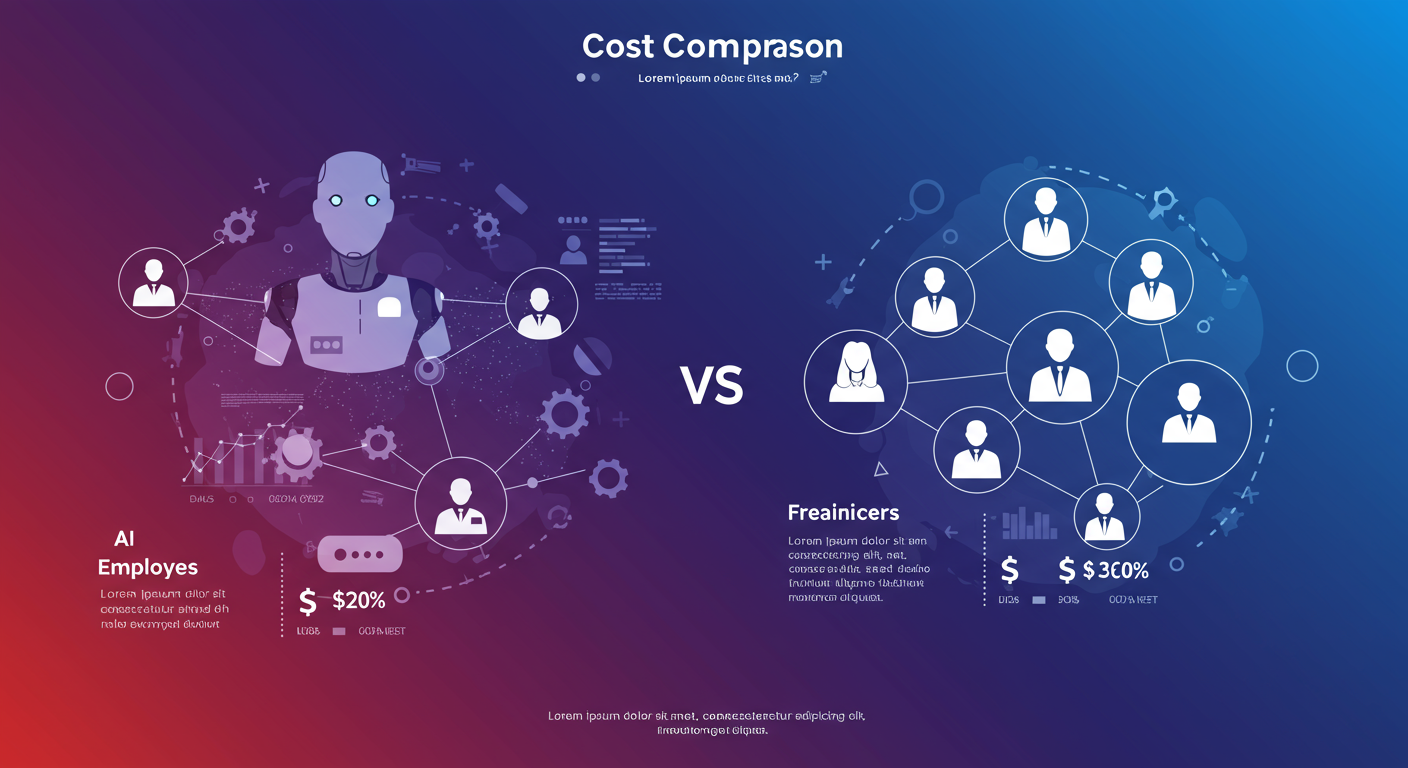
The biggest misconception in this comparison is that AI employees are always cheaper. They are cheaper per task for high-volume repetitive work. They are not cheaper when the task requires revision cycles, creative direction, or domain expertise.
AI employee platforms and their actual pricing:
- SweetPilot: four plans from $9/mo (Starter, 350 credits) to $270/mo (Enterprise, 14,000 credits), with Pro at $45/mo for 2,100 credits; every plan includes all 17 AI employees
- Lindy.ai: paid plans start at $29.99/mo for workflow automations across sales, support, and operations
- Relevance AI: free tier available, paid plans from $19/mo for AI agent workflows
- Bland AI: usage based pricing starting around $0.09/min for AI phone agents
Freelancer cost ranges by category (based on Upwork and Toptal 2025-2026 rates):
- Virtual assistants: $10 to $30/hr
- Content writers: $25 to $75/hr
- Graphic designers: $30 to $80/hr
- Web developers: $50 to $150/hr
- Marketing strategists: $75 to $200/hr
- Specialized consultants (legal, finance, data science): $100 to $300/hr
The crossover point matters. If you need 40 hours/month of email triage, an AI employee at $45/mo beats a VA at $15/hr ($600/mo) by a factor of about 13x. If you need 10 hours of brand strategy, no AI tool can do that work at any price.
The hidden cost most businesses miss with freelancers is management overhead. Finding, vetting, briefing, reviewing, and providing feedback to freelancers takes time. For AI employees, the hidden cost is setup and prompt engineering. A poorly configured AI employee can waste more time than it saves.
Which Tasks Should Go to AI and Which Should Go to Freelancers?
This is where most comparison articles fail. They list generic pros and cons without telling you what to actually assign where. Here is a concrete breakdown:
Tasks where AI employees outperform freelancers:
- Email sorting, labeling, and first-draft responses
- Calendar management and meeting scheduling across time zones
- Data entry and CRM updates from structured inputs
- Social media post scheduling from pre-approved templates
- Invoice processing and payment reminders
- Customer support ticket routing and FAQ responses
- Lead qualification based on predefined scoring criteria
- Report generation from existing data sources
Tasks where freelancers outperform AI employees:
- Brand strategy, positioning, and messaging development
- Original content creation that requires a unique voice or perspective
- Software development beyond simple scripts or automations
- Graphic design for campaigns, packaging, or branding
- Video production, editing, and motion graphics
- Legal document review and contract negotiation
- Financial modeling and strategic planning
- Crisis communication and PR management
Tasks where the answer depends on complexity:
- Blog writing: AI can draft structured, informational posts; freelancers are needed for thought leadership or pieces requiring interviews and original research
- Social media management: AI handles scheduling and basic engagement; freelancers handle strategy, community building, and creative campaigns
- Customer support: AI handles tier 1 and FAQ-based inquiries; freelancers or in-house staff handle escalations and complex issues
The deciding factor is not the task category but the level of judgment required. If the task has clear inputs, defined rules, and predictable outputs, AI wins. If the task requires interpretation, persuasion, or creative problem-solving, a freelancer wins.
Where AI Employees Fail and What Most Platforms Will Not Tell You
AI employee platforms market themselves as replacements for human workers. They are not. Here are the specific failure modes:
Context collapse: AI employees process each task independently. They do not remember that a client was upset last week or that a project's scope changed in a meeting yesterday. Freelancers carry context across interactions naturally.
Quality degradation on edge cases: AI employees perform well on the 80% of tasks that fit their training patterns. The remaining 20% (unusual requests, ambiguous instructions, tasks requiring cultural sensitivity) produce outputs that range from wrong to embarrassing.
No pushback or strategic input: A good freelancer will tell you when your brief is unclear, your timeline is unrealistic, or your approach is wrong. AI employees execute whatever you instruct, even if the instruction is flawed.
Integration brittleness: AI employees work well within their supported integrations. When your workflow involves a tool the platform doesn't support, you hit a wall. Freelancers adapt to whatever tools you use.
Compliance and liability gaps: If an AI employee sends an incorrect response to a customer or generates content that infringes on copyright, the liability question is unresolved in most jurisdictions. With freelancers, contracts define responsibility clearly.
SweetPilot is transparent about these boundaries. Its AI employees are designed for structured, repeatable workflows (email, scheduling, research, support), not for replacing strategic human roles. Platforms that claim otherwise are overselling.
A Decision Framework for Choosing Between AI Employees and Freelancers
Instead of generic advice, use this framework to evaluate each task or function:
Step 1: Classify the work by judgment level
- Low judgment (clear rules, structured data, repetitive): assign to AI
- Medium judgment (some interpretation needed, mostly predictable): test with AI, have a freelancer review
- High judgment (ambiguous inputs, strategic impact, creative output): assign to freelancer
Step 2: Calculate the true cost per outcome
- For AI: monthly subscription + setup time + error correction time
- For freelancers: hourly rate x estimated hours + management overhead + revision cycles
Step 3: Assess the risk of a bad output
- Low risk (internal report, data sorting): AI is fine even if output quality varies
- Medium risk (client-facing email, blog post): AI draft with human review
- High risk (legal document, public campaign, financial decision): freelancer only
Step 4: Consider the timeline
- AI employees are available immediately and produce output in minutes
- Freelancers require sourcing (1 to 5 days on platforms like Upwork or Toptal), briefing, and turnaround time
- For urgent, structured tasks, AI wins by default
Step 5: Evaluate the learning curve
- AI employees require prompt engineering and workflow configuration upfront but scale after that
- Freelancers require onboarding per person but adapt faster to new requirements
Most businesses with 5 to 50 employees find the optimal split is roughly 60% AI / 40% freelancer by task volume, but 30% AI / 70% freelancer by strategic value. The volume tasks go to AI. The tasks that move the business forward go to humans.
How to Run a Hybrid AI and Freelancer Workflow Without Creating Chaos
The hybrid approach sounds logical but fails in practice when there is no system for routing work. Here is what actually works:
- Define ownership boundaries upfront. Every recurring task gets assigned to either AI or a freelancer, not both. Overlap creates confusion about who is responsible for quality.
- Use AI for the first pass, freelancers for the final pass. This works particularly well for content, customer communications, and research. AI generates the draft or summary; the freelancer refines, adds judgment, and approves.
- Set up monitoring for AI outputs before trusting them. SweetPilot and similar platforms let you review AI employee actions before they execute. Use this review period for the first 2 to 4 weeks until you understand the error patterns.
- Brief freelancers on what the AI handles. Freelancers waste time if they do not know what has already been automated. Share your AI workflow map so they can focus on the gaps.
- Centralize communication in one tool. If AI outputs go to Slack and freelancer deliverables arrive via email, things get lost. Pick one system of record and route everything there.
- Track cost per outcome, not cost per hour or cost per task. The metric that matters is: how much did it cost to produce a completed, quality-checked deliverable? This lets you compare AI and freelancer efficiency on equal terms.
The businesses that succeed with hybrid workflows treat AI employees as infrastructure (always on, handling volume) and freelancers as specialists (engaged for specific outcomes). The ones that fail try to use AI employees as cheap freelancers or freelancers as expensive AI employees.
FAQs
Q1: Can AI employees fully replace freelancers for content writing?
Answer: Not for content that requires original perspective, interviews, or thought leadership. AI employees can draft structured, informational content like product descriptions, FAQ pages, and data-driven reports. For blog posts that need a unique voice, original research, or persuasive argumentation, a freelancer produces better results. The practical approach is using AI for first drafts and freelancers for final editing and original pieces.
Q2: How much can a small business save by switching from freelancers to AI employees?
Answer: For repetitive tasks like email management, scheduling, and data entry, a small business spending $500 to $2,000/mo on virtual assistants can reduce that to $9 to $90/mo with AI employee platforms like SweetPilot. However, savings only apply to structured, repeatable work. Tasks requiring creativity or judgment still need human freelancers, so total savings depend on what percentage of your current freelance spend covers automatable tasks.
Q3: What is the biggest risk of relying too heavily on AI employees?
Answer: Context loss. AI employees process each task in isolation without remembering prior interactions, relationship history, or evolving project context. This leads to responses that are technically correct but miss important nuances. Businesses that over-rely on AI for client-facing communication often discover this when a customer complains about receiving generic or tone-deaf responses.
Q4: Which freelancer platforms work best alongside AI employee tools?
Answer: Upwork works well for ongoing relationships with vetted freelancers who handle the strategic work AI cannot do. Toptal is better for specialized technical talent (developers, designers, finance experts) at higher rates but more consistent quality. Fiverr suits one-off creative tasks like logo design or video editing. Pair any of these with an AI employee platform like SweetPilot that handles the administrative and repetitive tasks surrounding the freelancer's core work.
Q5: How do I know if a task is better suited for AI or a freelancer?
Answer: Apply a simple test: does the task have clear inputs, defined rules, and predictable outputs? If yes, assign it to AI. Does it require interpretation, persuasion, cultural awareness, or creative problem-solving? If yes, assign it to a freelancer. For tasks in the middle, start with AI and have a freelancer review the output for the first few cycles to calibrate quality expectations.
Q6: Is it worth using both AI employees and freelancers for the same project?
Answer: Yes, when structured correctly. The most effective pattern is AI handling the volume and preparatory work (research, data gathering, first drafts, scheduling) while freelancers handle the judgment-intensive work (strategy, creative direction, final approval). This reduces freelancer hours (lowering cost) while improving their output quality because they receive better-prepared inputs. The key is defining clear handoff points so both sides know exactly what they own.
Conclusion
AI employees and freelancers are not competing options. They are different tools for different types of work. AI employees handle volume, structure, and repetition at a fraction of the cost of human labor. Freelancers handle complexity, creativity, and strategic thinking that no AI platform can replicate.
The practical decision is not choosing one over the other but mapping your business operations to determine which tasks belong where. Start by listing every recurring task, classifying each by judgment level and risk, and assigning accordingly.
The strategic implication is that businesses that figure out this split early gain a compounding advantage. They free up budget by automating volume tasks, reinvest that budget into higher-quality freelance talent for strategic work, and end up with both better efficiency and better outcomes than competitors who go all in on either option. SweetPilot's AI employees are built for the volume side of this equation, handling email, scheduling, research, and support so your budget stretches further for the human talent that drives growth.