Quick Overview
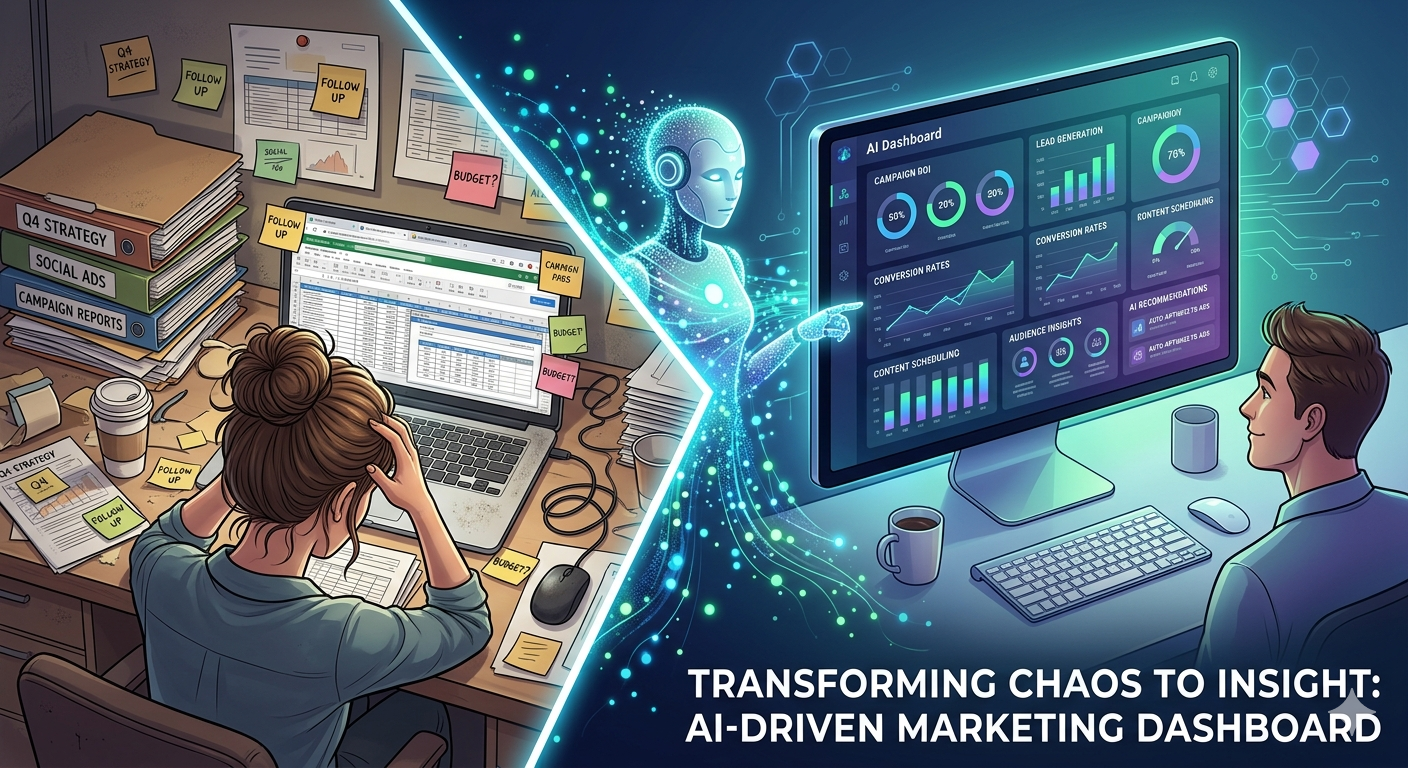
Marketing teams are stretched thinner than ever, and most of the strain comes from repetitive execution work rather than strategy. AI agents change that equation. This guide breaks down the 10 marketing tasks worth automating immediately, from SEO content and social scheduling to ad copy, competitor research, and weekly reporting. Each task is mapped to a specific SweetPilot agent, including Ink for content, Aria for social, and Atlas for analytics, with a concrete example of the output you'll get. We close with a 30 minute setup walkthrough and a realistic before and after look at the time you'll reclaim.
Introduction
Many marketing teams operate under the assumption that automation is only suitable for repetitive, low-skill tasks. This perspective, however, overlooks the transformative potential of AI in marketing. AI is not just about automating mundane tasks; it’s about enhancing decision-making processes and delivering personalized customer experiences at scale. This post covers ten critical marketing tasks that can be automated using AI, providing a comprehensive understanding of how AI can revolutionize marketing operations. By the end, readers will have a clear strategy for integrating AI into their marketing processes, balancing the benefits against the costs and challenges.
AI for Marketing Teams: 10 Tasks You Should Automate Right Now
Marketing teams are drowning. The channel count keeps growing, the content demand never stops, and the headcount rarely keeps pace. Most marketers spend their week firefighting execution work instead of doing the strategic thinking they were hired for.
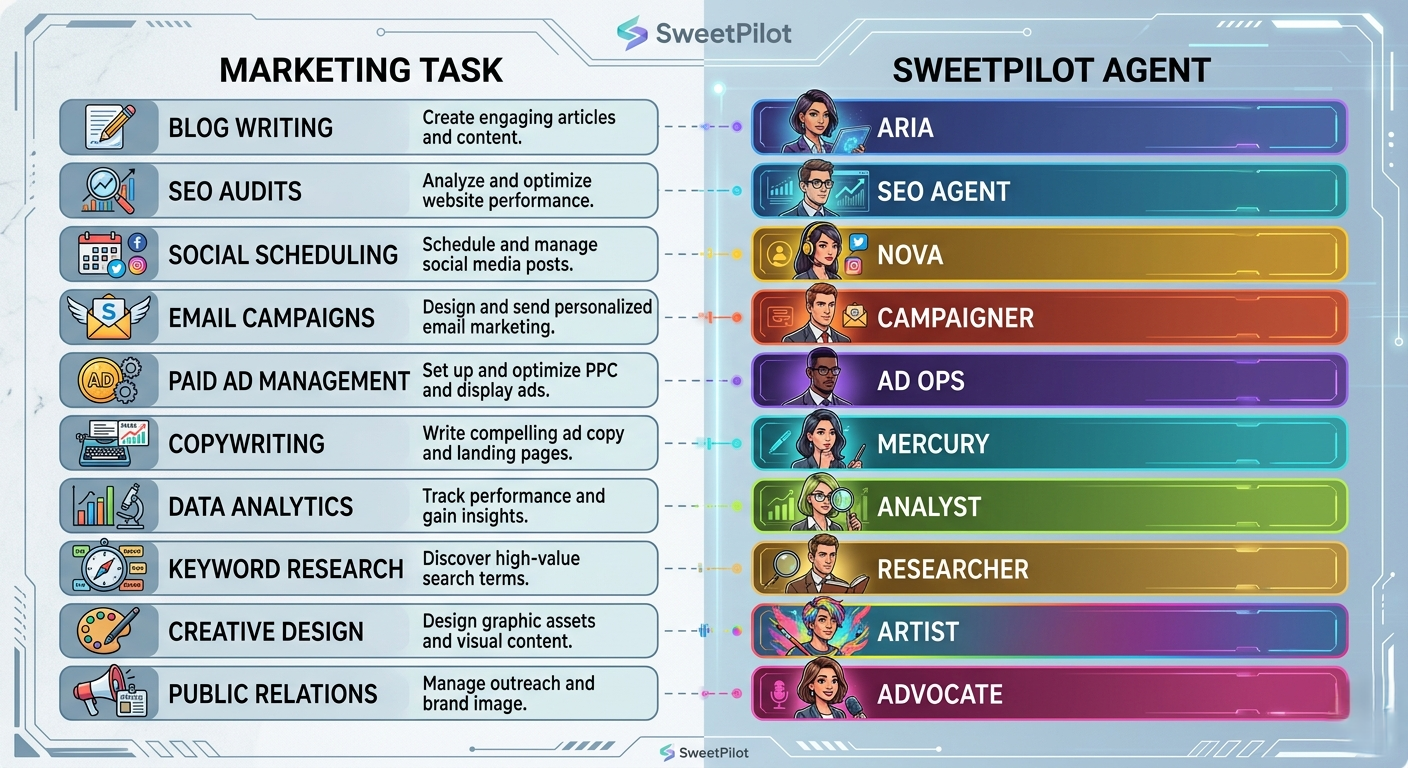
Here's the good news. The exact tasks burning your team's hours are the ones AI agents handle best. Not "someday" AI. Today AI. In this guide we map the 10 highest value marketing tasks to automate right now, each tied to the specific SweetPilot agent that owns it and the output you can expect on day one.
Why Marketing Teams Are Turning to AI Agents
The math behind the shift is simple.
Marketers consistently report spending more than 50 percent of their week on repetitive, low judgment work: reformatting content, scheduling posts, pulling reports, writing variations of the same email. That's half a salary spent on tasks that don't require strategic thinking.
The cost isn't just hours. It's burnout. Marketing has one of the highest turnover rates of any business function, and "too much repetitive work" is a top reason cited in exit interviews. Your best strategists quit because they spend their days on production line tasks.
AI agents flip the ratio. They take the execution layer, content drafts, scheduling, reporting, follow ups, so your humans spend their time on positioning, creative direction, and customer insight. The teams adopting this in 2026 aren't producing less. They're producing far more with the same headcount.
The 10 Marketing Tasks to Automate
Here are the 10 tasks worth automating first, ranked by impact and ease of handoff.
1. Blog Writing
The task: Researching, outlining, drafting, and optimizing long form blog content.
Why automate it: A single quality blog post takes a human writer 4 to 6 hours. At a cadence of 8 posts a month, that's an entire work week gone.
SweetPilot agent: Ink, the copywriter.
Expected output: Give Ink a topic, a target keyword, and an audience. It returns an SEO structured article draft in your brand voice, complete with an outline, intro, body sections, FAQs, and a CTA. It reads your past content from Brain AI so the tone can match yours.
2. SEO Audits
The task: Analyzing pages for on page SEO issues, keyword gaps, and internal linking opportunities.
Why automate it: SEO audits are detailed, repetitive, and easy to postpone. Postponed audits mean lost rankings.
SweetPilot agent: Orbit, the SEO expert.
Expected output: Paste a page link and Orbit reads the page, then returns a prioritized list of on page fixes, missing meta data, keyword targeting recommendations, and internal link suggestions. It reads the pages you link, up to three links per message, rather than crawling a whole site.
3. Social Media Scheduling
The task: Writing platform specific captions and scheduling posts across channels.
Why automate it: Social is a daily grind. Caption writing and scheduling alone can eat 8 to 10 hours a week.
SweetPilot agent: Aria, the social media manager.
Expected output: Ask Aria for a week of content. She returns captions written for LinkedIn, X, and Instagram, each tied to your positioning, ready to schedule to your connected accounts.
4. Email Copy
The task: Drafting newsletters, welcome sequences, promotional emails, and follow ups.
Why automate it: Email is your highest ROI channel, but writing it is slow and repetitive.
SweetPilot agent: Echo, the email marketing employee.
Expected output: Describe a campaign and Echo returns a complete sequence: subject lines, preview text, body copy, and CTAs, all in your brand voice and ready to load into your ESP.
5. Ad Copy
The task: Writing headlines, body copy, and variations for paid campaigns.
Why automate it: Good paid performance needs constant fresh creative. Manual variation writing can't keep pace.
SweetPilot agent: Ink, the copywriter.
Expected output: Give Ink a product and an offer. It returns headline and body copy variations written for Google, Meta, and LinkedIn ads, ready for A B testing.
6. Competitor Research
The task: Tracking competitor messaging, pricing, content, and positioning.
Why automate it: Competitive intelligence is valuable but always the first thing to slip when the team is busy.
SweetPilot agent: Sage, the business strategist.
Expected output: Paste links to a competitor's pages and Sage returns a structured teardown: their positioning, messaging angles, content themes, pricing, and the gaps you can exploit.
7. Weekly Reports
The task: Pulling performance data and turning it into a readable summary.
Why automate it: Reporting is pure overhead. It informs decisions but creates nothing on its own.
SweetPilot agent: Atlas, the data analyst.
Expected output: Attach last week's traffic, conversion, and channel export as a CSV, or point Atlas at a connected Google Sheet. It identifies the three biggest movers and writes a one page summary with recommendations.
8. Product Descriptions
The task: Writing consistent, persuasive, SEO friendly product copy at scale.
Why automate it: Ecommerce catalogs can run into thousands of SKUs. Manual writing simply doesn't scale.
SweetPilot agent: Flux, the ecommerce manager.
Expected output: Feed Flux your product specs. It returns benefit driven, SEO friendly descriptions in a consistent brand voice that you can paste into Shopify or your CMS.
9. Customer FAQs
The task: Writing and maintaining help content and answering repetitive customer questions.
Why automate it: The same questions arrive every day. Answering them manually is a permanent drain.
SweetPilot agent: Nova, the customer support employee.
Expected output: Working from the help docs you add to Brain AI, Nova drafts FAQ entries and customer replies in your brand voice, ready for you to publish or send.
10. Lead Follow Up
The task: Sending timely, personalized follow ups to leads and prospects.
Why automate it: Speed to lead is everything, and manual follow up always slips when the team is busy.
SweetPilot agent: Spark, the sales specialist.
Expected output: Spark drafts personalized outreach and follow up emails in your connected Gmail account and waits for your approval before anything is sent, so leads get a considered reply while your team is heads down on other work.
How to Set Up Your AI Marketing Team in Under 30 Minutes
You don't need a long rollout. Here's the full setup in four steps.
Step 1: Choose a Plan (2 minutes)
Sign up for SweetPilot and choose a plan. Plans start at $9 per month with 350 credits, and every plan includes every AI employee, so you can build your whole marketing team on the smallest plan. There is no free plan; a 14 day money back guarantee applies.
Step 2: Train Brain AI (15 minutes)
Upload your brand guidelines, tone of voice doc, top performing past content, product info, and customer personas. This is the single highest leverage step. Every agent reads from Brain AI, so the more you load, the more the output sounds like you.
Step 3: Assign Your First Three Agents (8 minutes)
Don't onboard all 17 at once. Start with the three tasks eating the most time. For many marketing teams that's Ink for content, Aria for social, and Atlas for reporting. Assign each one a real task and review the output.
Step 4: Set Schedules (5 minutes)
Turn one off tasks into recurring work. Schedule social posts from the content calendar, and use Canvas, the visual workflow builder, to run recurring workflows on a schedule. Now the routine runs without a daily prompt.
Total time: under 30 minutes. By the end you have a working AI marketing team.
Before vs After: Life with an AI Marketing Team
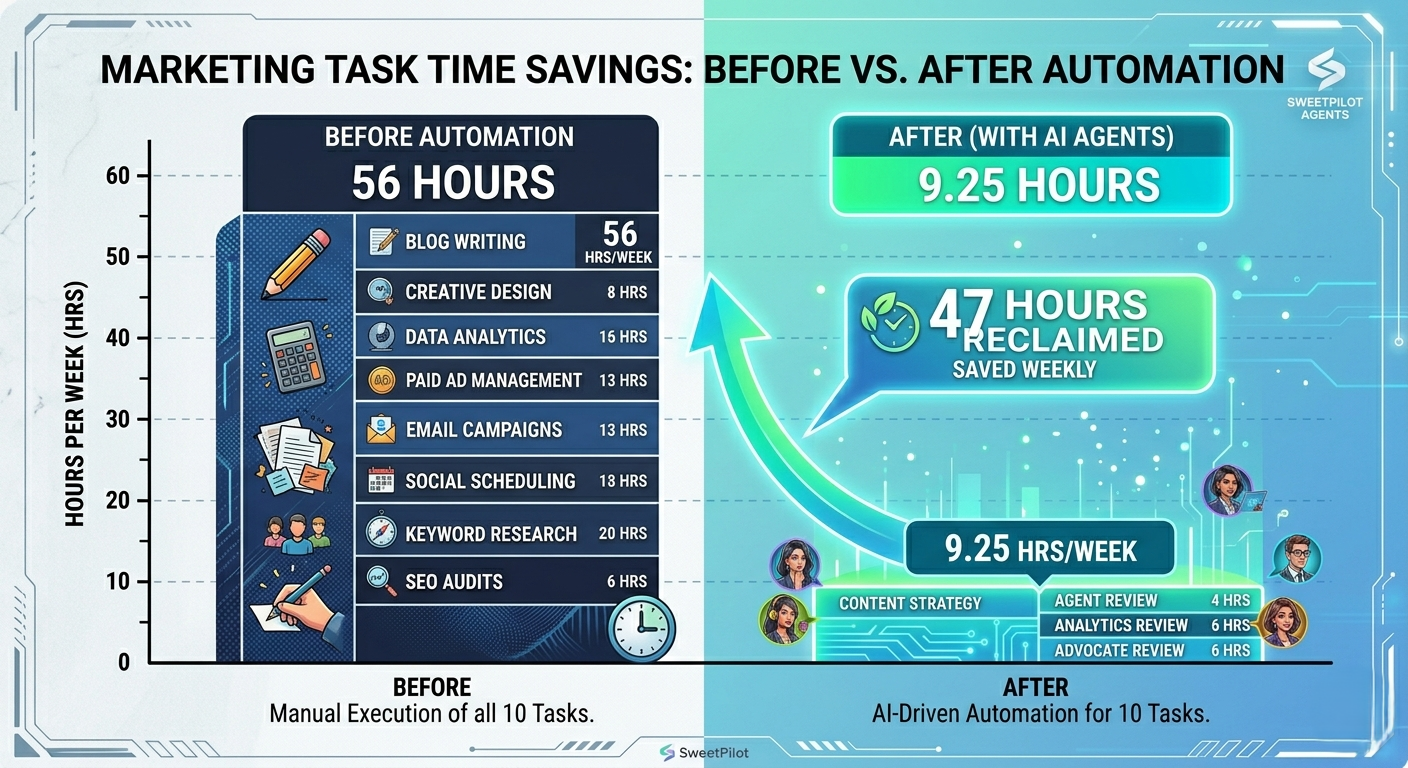
Here's an illustrative week for a small marketing team of three, before and after automation. The hours are an example, not measured customer data.
| Task | Before (hours/week) | After (hours/week) |
|---|---|---|
| Blog writing | 10 | 2 (review only) |
| SEO audits | 4 | 0.5 |
| Social scheduling | 9 | 1 |
| Email copy | 6 | 1.5 |
| Ad copy | 5 | 1 |
| Competitor research | 3 | 0.5 |
| Weekly reports | 4 | 0.25 |
| Product descriptions | 4 | 0.5 |
| Customer FAQs | 5 | 1 |
| Lead follow up | 6 | 1 |
| Total | 56 hours | 9.25 hours |
That's roughly 47 hours a week returned to the team, more than one full time equivalent. And those reclaimed hours go to strategy, creative direction, and customer research, the work that actually moves the business.
The team isn't smaller. It's doing higher value work with an AI workforce handling production.
##FAQs
Q1: What AI tools do marketing teams use?
Answer: Marketing teams in 2026 use a mix of specialized AI agents rather than a single chatbot. Platforms like SweetPilot give you dedicated agents for content, SEO, social, email, ads, research, analytics, and support, all trained on your brand. This beats stitching together separate point tools because every agent shares one knowledge base.
Q2: Can AI handle content marketing?
Answer: Yes, for the execution layer. AI agents handle blog drafts, social captions, email copy, product descriptions, and SEO optimization at scale. Humans still own strategy, positioning, and creative direction. The most effective setup pairs an AI workforce for production with human marketers for judgment.
Q3: How much can AI reduce marketing costs?
Answer: Significantly. A team that automates the 10 tasks in this guide could reclaim tens of hours a week on the example above. With SweetPilot plans ranging from $9 to $270 per month, the cost of the AI team is a fraction of a single marketing salary.
Q4: Will AI replace my marketing team?
Answer: No. AI replaces repetitive execution work, not marketers. The teams winning in 2026 keep their strategists and creatives, and use AI agents to handle the production tasks that used to consume half the week. The result is a leaner, higher output team.
Q5: How long until I see results?
Answer: You can get usable output on day one. The quality climbs as you add more context to Brain AI, so the agents get sharper the longer you use them.
Q6: Which marketing task should I automate first?
Answer: Start with whatever consumes the most hours on your team. For most marketing teams that's blog writing or social scheduling. Automate one task, prove the value, then expand to the rest.
Conclusion
Marketing has always been a balance between strategy and execution. For too long, execution has won, swallowing the hours that should go to thinking, positioning, and understanding customers. AI agents finally tip the balance back.
The 10 tasks in this guide, blog writing, SEO audits, social scheduling, email copy, ad copy, competitor research, weekly reports, product descriptions, customer FAQs, and lead follow up, are all ready to automate today. Each one maps to a specific SweetPilot agent, and together they can return more than a full work week to your team.
You don't have to automate all 10 at once. Start with one. Prove it. Expand from there.
Build your AI marketing team today. Choose a plan, train Brain AI, and assign your first agent in under 30 minutes.